Knowing how to clean roof shingles the right way can extend the life of your roof, restore your home’s curb appeal, and prevent minor discoloration from turning into serious damage. Dark streaks, moss growth, and lichen patches are common problems that respond well to proper cleaning techniques, but the wrong tools and products can do far more harm than good. This guide walks Pittsburgh homeowners through the seven tools, tips, and products that actually work for cleaning asphalt shingles, plus the safe process to follow from start to finish.
- What to use: The right products and tools for effective, damage-free cleaning.
- What to avoid: The tools and methods that damage shingles and void warranties.
- Safety framework: Practical steps to protect yourself, your home, and your landscaping.
Why Roof Shingles Get Dirty and When to Clean Them
Roof shingles collect biological growth and debris over time, and the discoloration is usually more than an aesthetic issue. Understanding the cause guides the treatment and helps you decide whether cleaning is the right step or whether the roof is past the point of restoration.
What Causes the Discoloration
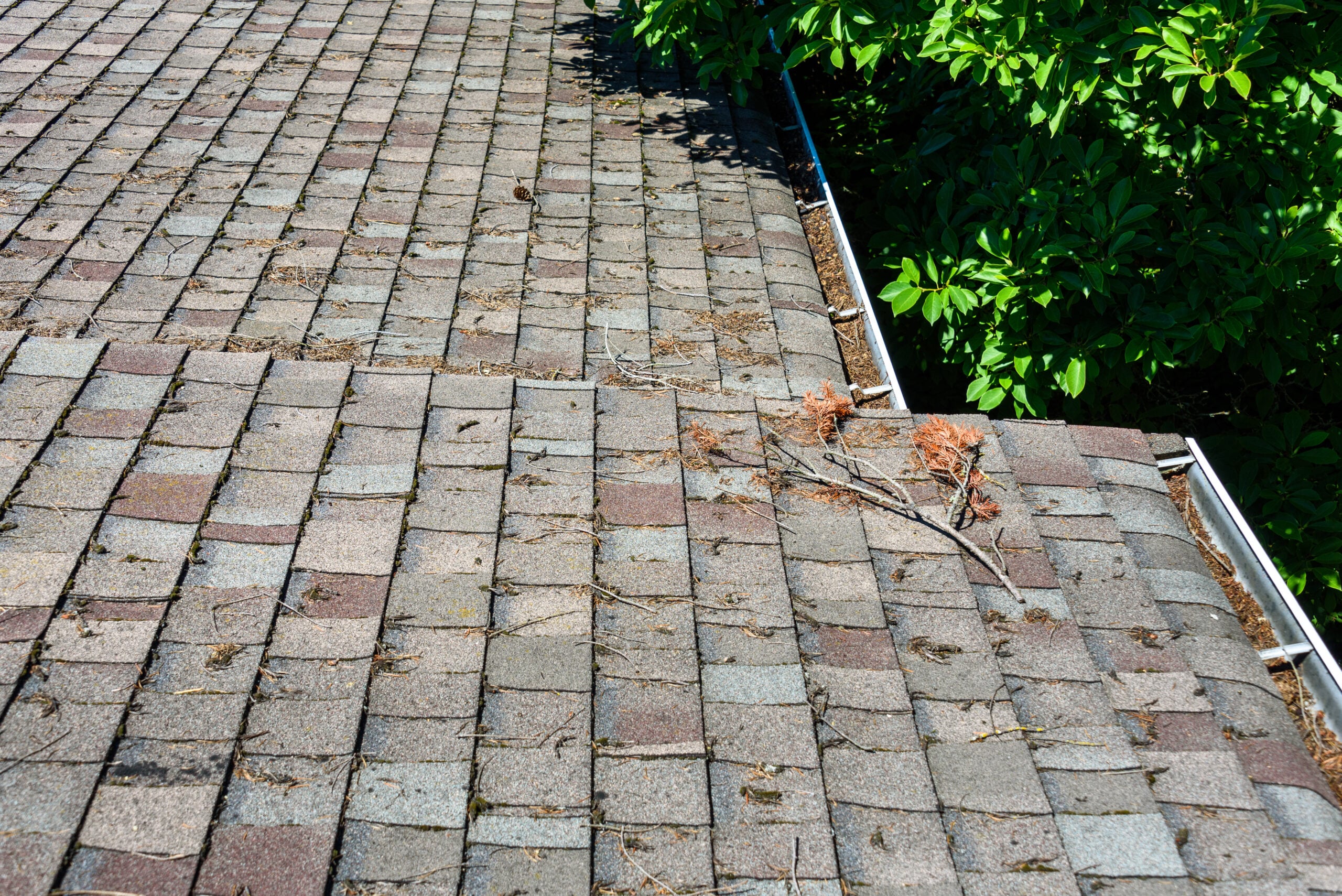
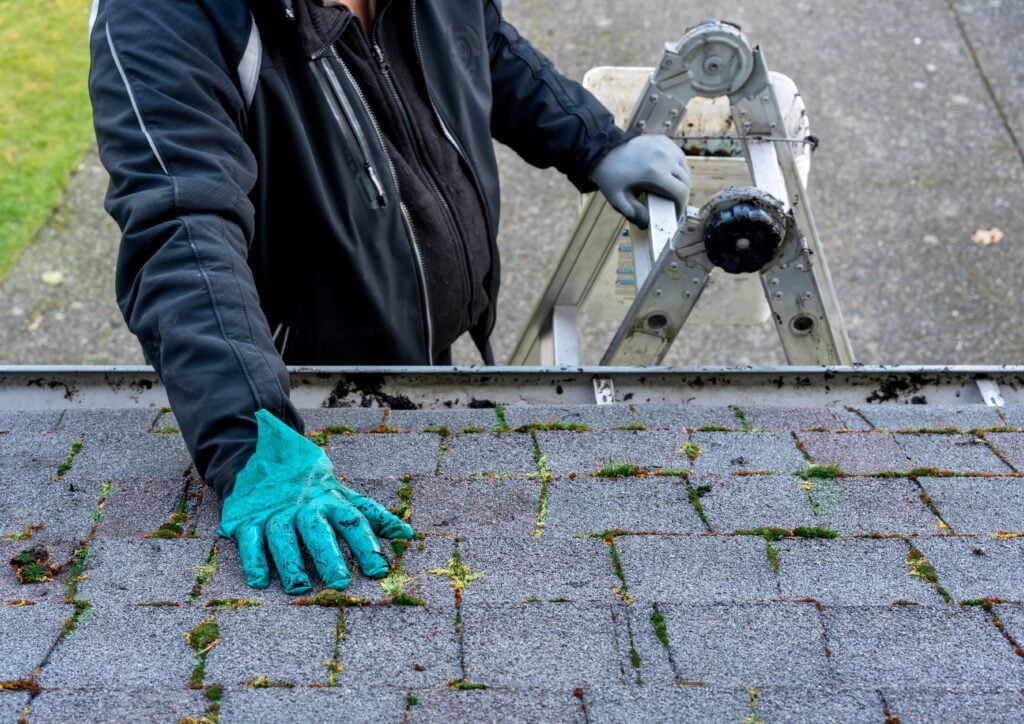
The dark streaks most homeowners notice on their roof are caused by a specific type of algae called Gloeocapsa magma, which travels through the air and settles on roofs in humid conditions. Moss, lichen, and mildew each grow in shaded areas with poor drying conditions, and homes surrounded by trees or with north-facing roof planes see the worst of it. Debris from overhanging branches, pine needles, and airborne dust adds to the problem by holding moisture against the shingle surface. Pittsburgh homes and homes across surrounding areas with heavy tree cover typically show the most visible discoloration on the shaded slopes.
- Algae streaks: Dark brown or black streaks caused by Gloeocapsa magma.
- Moss growth: Green cushiony patches thrive on shaded, damp slopes.
- Lichen colonies: Circular gray or green patches with a crusty texture.
- Debris accumulation: Leaves, needles, and dirt hold moisture against the shingle.
When to Clean vs. When to Replace
Cleaning is the right call when the shingles are structurally sound, granule loss is minimal, and the discoloration is primarily surface-level algae or moss. Cleaning is not enough when granules are missing across large areas, shingles are curling, cupping, or lifting, or the roof is past 20 years old and showing multiple failure signs. In those cases, cleaning simply masks the deeper issue and delays the inevitable replacement. Homeowners should evaluate the roof honestly before spending on cleaning that a full re-roof would render moot.
- Cleaning candidates: Structurally sound roofs with primarily cosmetic staining.
- Replacement signals: Widespread granule loss, curling, cupping, or lifting shingles.
- Age consideration: Roofs over 20 years with multiple issues rarely benefit from cleaning.
- Honest evaluation: Cleaning cannot restore a roof that has already failed.
7 Tools, Tips, and Products for Cleaning Roof Shingles
The seven items below cover everything you need to clean asphalt shingles the right way. Missing any of these tools or skipping the associated tips risks damaging the roof, voiding the warranty, or creating a serious safety hazard.
1. Sodium Hypochlorite (Bleach) Solution
Sodium hypochlorite, the active ingredient in household bleach, is the industry-standard cleaner for asphalt shingles because it kills algae, moss, and lichen without damaging the shingle surface. The Asphalt Roofing Manufacturers Association recommends a solution of liquid household bleach and water applied gently to the roof, left in place for at least 15 minutes but no more than 20 minutes, then rinsed with low-pressure water, and specifically warns against using pressure washers or scrubbing brushes because both cause granule loss. A common mix is one part bleach to three parts water for moderate staining, adjusted higher or lower based on severity.
- Approved active ingredient: Sodium hypochlorite (liquid household bleach).
- Standard mix: One part bleach to three parts water for moderate staining.
- Dwell time: 15 to 20 minutes, never allowed to fully dry.
- Warning: Never scrub or pressure wash the surface.
2. Low-Pressure Garden Sprayer
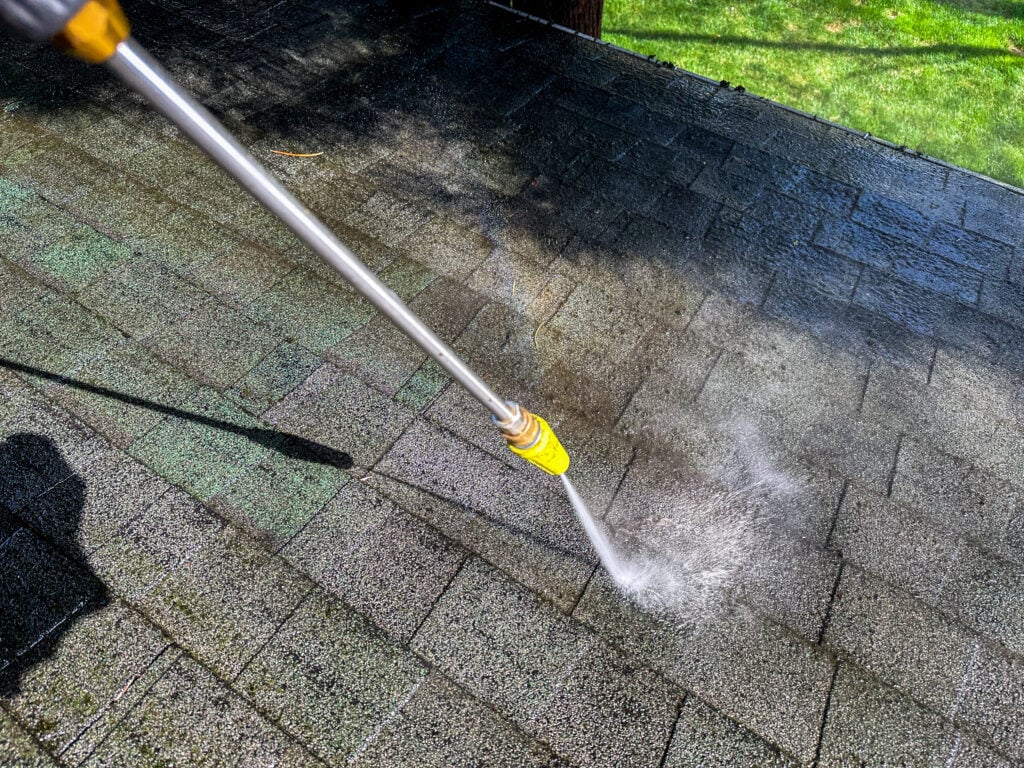
A standard pump-up garden sprayer is the safest way to apply the bleach solution evenly across the shingles. High-pressure equipment is expressly prohibited by all major shingle manufacturers because it strips granules from the surface, so a simple pump sprayer that costs less than $30 is the right tool. Apply from a ladder or a low-slope walking area, working from the bottom up so the cleaner soaks the shingles it will run over. Multiple light passes work better than one heavy application.
- Sprayer type: Standard pump-up garden sprayer, 1-2 gallon capacity.
- Application direction: Bottom-up to keep upper shingles wet longer.
- Coverage strategy: Multiple light passes rather than one heavy soak.
- Cost estimate: Under $30 for a quality residential sprayer.
3. Extension Ladder and Fall Protection
Roof cleaning requires safe access to the roof, and that starts with a proper extension ladder set on level ground and secured against slipping. Ladders should extend at least three feet above the roofline, be tied off to a stable anchor point, and have a stabilizer bar attached to spread the load. For any work above ten feet, a fall arrest harness, roof anchor, and lifeline are strongly recommended because the wet, chemically treated surface becomes dangerously slippery during and after cleaning.
- Ladder height: Extension three feet above the roofline.
- Stability: Set on level ground, tied off at the top.
- Harness system: Required for any work above 10 feet.
- Wet-surface warning: Treated shingles are slippery and hazardous to walk on.
4. Wet & Forget or Similar Ready-to-Use Product
Homeowners who want a simpler alternative to mixing bleach can use ready-to-use roof cleaning products like Wet & Forget, Spray & Forget, or 30 Seconds Outdoor Cleaner. These products contain algaecides that work over weeks rather than minutes and are applied in a single pass without rinsing. They tend to be less aggressive than bleach mixes, which makes them safer for landscaping and gentler on shingles, though they take longer to show results and typically cost more per square foot of coverage.
- Common brands: Wet & Forget, Spray & Forget, and 30 Seconds Outdoor Cleaner.
- Application: Single-pass spray with no rinsing required.
- Timeline: Results appear over several weeks rather than immediately.
- Advantages: Gentler on landscaping and less risk of overspray damage.
5. Copper or Zinc Strips for Long-Term Prevention
Installing copper or zinc strips along the ridge of the roof prevents future algae and moss growth by releasing trace amounts of metal ions during rainfall. As water flows down the roof, it carries those ions across the shingle surface and inhibits biological growth. The strips typically last 20 years or more, are inexpensive to install, and are the single most effective long-term prevention strategy after a thorough cleaning. Zinc is more affordable, while copper is more durable and works over longer distances.
- Placement: Along the ridge, running the full length of each roof plane.
- Mechanism: Metal ions in runoff inhibit algae and moss growth.
- Zinc vs. copper: Zinc is cheaper, copper lasts longer and covers more area.
- Longevity: 20-plus years of protection from a single installation.
6. Garden Hose with Low-Pressure Rinse Nozzle
The rinse step is as important as the application step. A standard garden hose with a fan or shower spray nozzle provides the gentle, high-volume rinse needed to remove the cleaning solution without dislodging granules. Never use a pressure washer, even at a low setting, because the concentrated stream removes protective granules and shortens shingle life significantly. Rinse from the top down after the dwell time is complete, working slowly across each section.
- Nozzle type: Fan or shower spray, not concentrated jet.
- Rinse direction: Top-down, opposite of the application direction.
- Water volume: High volume at low pressure.
- Absolute rule: Never substitute a pressure washer for a garden hose.
7. Landscape Protection Materials
Bleach solutions can damage or kill plants, grass, and delicate flower beds if runoff is not contained. Cover all landscaping within 20 feet of the home with plastic sheeting or heavy-duty tarps before starting work, and wet down surrounding plants with plain water immediately before and after cleaning to dilute any overspray. Have a garden hose ready to rinse plants if bleach contact occurs. Skipping this step commonly results in dead shrubs, damaged flower beds, and yellowed grass that takes weeks to recover.
- Protection radius: Landscaping within 20 feet of the home.
- Cover materials: Plastic sheeting or heavy-duty tarps.
- Water buffer: Wet plants before and after cleaning to dilute overspray.
- Emergency rinse: Keep a garden hose ready to flush accidental contact.
How to Clean Roof Shingles Step by Step
The seven tools and products above become effective when used in the right sequence. The steps below walk through the full cleaning workflow from prep to cleanup.
Preparing Your Home and Landscaping
Preparation is the most important step and takes 30 to 60 minutes for a typical Pittsburgh home. Cover landscaping with plastic or tarps, close all windows and doors, remove or cover outdoor furniture and grills, and pre-wet all surrounding plants with plain water. Confirm the weather forecast shows no rain for at least 24 hours, since rain during the dwell period washes away the solution before it can work. Choose an overcast day if possible, since direct sunlight causes the solution to evaporate too quickly.
- Landscape cover: Tarps or plastic sheeting on all vulnerable plants.
- Home protection: Close windows and doors, remove outdoor items.
- Weather timing: Overcast day with 24-plus hours of dry weather ahead.
- Pre-wet: Rinse all plants with plain water before starting.
The Cleaning Process
With prep complete, mix the bleach solution in the garden sprayer, ascend the ladder with proper safety equipment, and apply the solution to the shingles from the bottom up in a light, even coat. Let the solution dwell for 15 to 20 minutes without letting it dry, then rinse with a low-pressure garden hose from the top down. Repeat once if staining persists. Descend safely, clean up all equipment, rinse landscaping again to dilute any residual bleach, and remove protective tarps.
- Application: Bottom-up in a light even coat with the pump sprayer.
- Dwell time: 15 to 20 minutes, keeping the surface wet.
- Rinse: Top-down with a low-pressure garden hose.
- Cleanup: Remove tarps and rinse landscaping again after work is complete.
When to Call a Professional
DIY cleaning is reasonable for single-story homes with walkable pitches and homeowners comfortable with ladder work. Two-story homes, steep pitches, homes with complex rooflines, and any homeowner uncomfortable working at heights should hire a professional roof cleaning service. Professionals bring proper safety equipment, commercial-grade cleaners, and the experience to work safely on a wet, treated roof surface. Roof cleaning services in Pittsburgh and surrounding areas typically cost $400 to $1,200 for a full residential cleaning.
- DIY candidates: Single-story homes with walkable pitches.
- Hire-a-pro situations: Two-story homes, steep pitches, and complex rooflines.
- Safety priority: Fall risk on wet, treated shingles is significant.
- Professional cost: $400 to $1,200 for typical residential cleaning.
Frequently Asked Questions
How Often Should I Clean My Roof Shingles?
Most Pittsburgh-area asphalt roofs benefit from cleaning every 2 to 5 years, depending on tree cover, shade, and climate exposure. Homes surrounded by trees or with heavy north-facing exposure may need cleaning every 2 to 3 years, while sunnier homes with minimal debris may only need cleaning every 4 to 5 years.
Can I Use a Pressure Washer on Asphalt Shingles?
No, pressure washers must never be used on asphalt shingles. The concentrated water stream strips protective granules, dramatically shortens shingle life, and voids most manufacturer warranties. Low-pressure garden hose rinsing is the only acceptable water application method.
Does Roof Cleaning Damage Shingles?
Properly done cleaning with sodium hypochlorite and low-pressure application does not damage shingles. Damage comes from scrubbing, pressure washing, harsh chemicals, and walking on wet treated shingles, all of which can be avoided with the right technique.
How Long Do the Results of Roof Cleaning Last?
Cleaning results typically last 2 to 5 years without preventive measures, and 8 to 15 years or longer when copper or zinc strips are installed along the ridge. Prevention is dramatically more cost-effective than repeated cleanings.
Will Roof Cleaning Void My Manufacturer Warranty?
Manufacturer-approved cleaning methods (low-pressure application of sodium hypochlorite solutions) do not void warranties. Pressure washing, scrubbing, and using non-approved chemicals will void warranty coverage from major manufacturers like GAF, Owens Corning, and CertainTeed.
Is There a Best Season for Cleaning Roof Shingles in Pittsburgh?
Late spring and early fall are the best seasons for roof cleaning in Pittsburgh and surrounding areas. Temperatures are moderate, rainfall is predictable, and landscaping is more resilient to accidental overspray than during peak summer or winter months.
Time for a New Roof? Contact McCormick Renovations
Cleaning can restore a healthy asphalt shingle roof, but no cleaning solution can bring back granules that have already washed away or shingles that have curled, cupped, or lifted past the point of repair. If your roof is showing widespread granule loss, is past the 20-year mark, or has multiple failure signs beyond cosmetic staining, replacement is the smarter investment. McCormick Renovations specializes in high-quality asphalt shingle roof replacements across Pittsburgh and surrounding areas, working with manufacturers like Owens Corning, Atlas, and GAF to install roofs that protect your home for decades. Reach out to McCormick Renovations today for a free estimate and honest assessment of whether cleaning or replacement is the right call for your home.